By The Leather Warehouse team. Last updated 14 October 2026.
Turmeric on the white shirt. Oil splatter across the blue one. A grey kurta that now carries a permanent, slightly orange memory of last Sunday’s curry.
If that sounds familiar, a kitchen apron is the cheapest fix you will ever buy. A wrong one is annoying in its own way, though: straps that dig into your neck, pockets too shallow for a phone, fabric that gives up the moment a pot boils over.
This guide helps you pick a kitchen apron that fits your body, your cooking and your budget. We make aprons in Delhi at The Leather Warehouse, so we hear what home cooks, café owners and potters ask for, and where first-time buyers go wrong. You’ll find straight answers on canvas versus leather, sizing, pockets, black aprons, men’s and women’s fits, pottery aprons, personalisation, care and price in ₹.
Short on time? Most people do well with a two-pocket canvas apron with adjustable cross-back straps. Keep reading if your situation is less typical.
What Is a Kitchen Apron, and Do You Really Need One?
A kitchen apron is a protective garment worn over your clothes while cooking, baking or cleaning up. It blocks oil, spills, flour and hot splashes, and its pockets keep tools within reach. You need one if you cook often, care about your clothes, or work in a kitchen where hygiene and presentation matter.
Plenty of people cook without one and survive. But count how often your front gets hit: the stove splash, the wet-hands wipe, the lean against a counter someone just cleaned. The apron takes all of that so your clothes don’t.
There’s a second job too. Pockets give the tasting spoon, the phone with the recipe open and the small towel a home, so they stop wandering around the kitchen.
What Are the Main Types of Kitchen Aprons?
The main types are the bib apron (covers chest to knee), the half or waist apron (ties at the waist and covers your legs only), the bistro apron (a longer waist apron), and the cross-back apron, where the straps cross behind you and spread weight across both shoulders.
Bib aprons give the most coverage, so they suit frying, grilling and messy prep. Waist aprons suit servers and baristas who want freedom to move. Cross-back designs are the most comfortable over long shifts because nothing hangs from your neck. Our own kitchen apron uses adjustable cross-back straps for exactly that reason.
You’ll also see chef apron, cooking apron and bakery apron on shop pages. Mostly those are labels. Check coverage, strap style and pocket layout instead.
What Fabric Should You Pick for a Kitchen Apron?
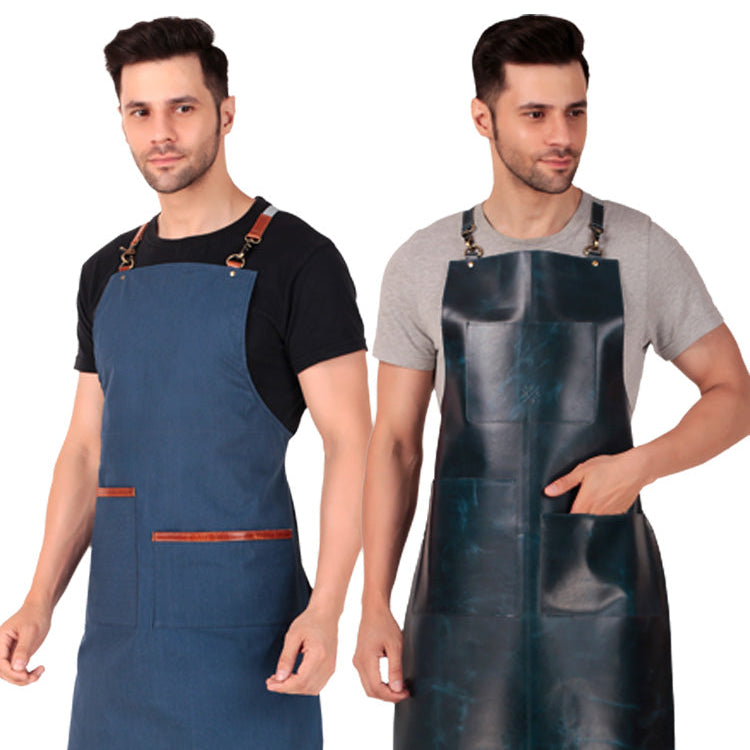
For most kitchens, heavy canvas is the best all-round material: it resists stains, holds its shape and survives daily wear. Cotton is lighter and cooler. PU leather wipes clean and looks sharp. Genuine leather lasts longest but suits dry, high-impact work better than wet jobs.
- Canvas: thick, tightly woven fabric that takes spills and constant washing or cleaning well. It’s the material behind most professional aprons. Browse our canvas aprons.
- Cotton: comfortable and easy to wash, but stains soak in faster and the fabric wears thin sooner.
- PU leather: a synthetic coating that wipes clean and costs less than real leather. It tends to crack or peel with age. See our PU leather aprons.
- Genuine leather: tough, ages with character, and handles a lot of abuse. More on that below.
Denim sits between cotton and canvas: sturdy and casual, and heavier on the body than you’d expect.
Quick comparison
|
Material |
Durability |
Water tolerance |
Care |
Best for |
|
Canvas |
High, holds shape under daily wear |
Resists spills, not soaking |
Check the label; ours is dry clean only |
Home kitchens, cafés, pottery |
|
Cotton |
Medium, thins sooner |
Absorbs liquid fast |
Usually easy to wash |
Light cooking and baking |
|
PU leather |
Medium, can crack or peel with age |
Wipes clean |
Wipe with a cloth |
Style-led, dry work |
|
Genuine leather |
Very high with care |
Poor when soaked |
Cloth wipe, dry cleaning |
Dry, high-impact work like grilling |
Is a Leather Apron Good for the Kitchen?
Yes, a leather apron works well for dry, messy kitchen work like grilling, prep and service. It resists spills and stains, and you can wipe it with a cloth. Skip it for work with a lot of water, such as dishwashing, because soaking is what damages leather.
If you want your leather apron to last, have it dry cleaned.. A damp cloth handles daily spills, but leather shouldn’t sit in water or go through a washing machine.
Be honest with yourself about weight and heat. A leather apron is heavier than canvas, and in a hot, closed kitchen you’ll feel it by the second hour. In return it looks better with every month of use.
Full-grain leather keeps the hide’s natural surface, which is where its texture, depth and character come from. On our canvas aprons the leather plays a lighter role: the canvas body is the practical everyday foundation, and the leather touches add visual character.
If that sounds right, look at our genuine leather apron or the vintage leather apron, priced at ₹3,799 and ₹3,999. Our guide to the best leather aprons for professional work goes deeper.
Why Do Cafés and Restaurants Choose Canvas Aprons?
Cafés and restaurants choose canvas because it handles daily wear, looks professional, and takes embossing or a logo well. A matching apron also makes staff look like a team, which guests notice before they taste anything.
Most cafés come to us for branding. A name or logo on the apron turns kitchen gear into part of the brand, and it helps chefs and floor staff look polished. Embossed names add a personal touch that staff appreciate. We also receive orders from major restaurants, so we’ve seen how uniform aprons work across a whole team.
If you’re outfitting a team, start with our hospitality range and our custom order service, which also handles custom sizes and bulk enquiries.
What Do Branded Aprons Look Like on a Real Team?
They look like uniforms: matching black aprons, each with the venue’s logo patch on the chest. Two of our customers show it. Gofornia’s team, photographed under a neon “Catch A Vibe” sign by the beach, wears black aprons with tan trim over orange tops. Saleem Studio’s six-person salon team wears black aprons with brown leather pocket panels.
In both photos the aprons carry the venue’s own branding, so staff read as one team before a guest says a word.
Photos: Gofornia (left) and Saleem Studio (right) teams in their custom aprons.
Who Makes The Leather Warehouse Aprons, and How?
The Leather Warehouse makes its aprons in Delhi, India. Artisans from the city’s local streets handcraft them, and the range spans canvas, denim, PU leather and genuine leather, with personalisation available on every product.
At the time of writing, our apron range lists 51 products, organised by profession (chef, salon, bakery, pottery, hotel and bar) and by material. We also make bags, folders and gifts, but aprons are built around the work people do in them. Read more about us, or see the leather and canvas aprons collection.
Teams at Gofornia and Saleem Studio wear our aprons, and our store is also on Amazon, Myntra and IndiaMart.
How Do You Match a Kitchen Apron to Your Work?
Choose an apron by checking four things: what your work involves (wet, dry, hot or messy), whether it fits you and has adjustable straps, which material suits the job (canvas for most people, leather for dry work), and how easily you can clean it. Decide on the colour last.
Here’s a quick way to decide:
- Cook at home a few times a week? A two-pocket canvas apron is plenty.
- Standing at a grill or stove for hours? Pick cross-back straps and longer coverage.
- Working with water or clay? Go canvas, not leather.
- Buying for a team or a gift? Decide on personalisation before you order, because custom pieces can’t be returned.
If you’re buying your first apron for any task, our beginner’s guide to buying the perfect apron covers the basics.
What Size Kitchen Apron Should You Buy?
Pick the size that covers chest to knee without restricting movement, and choose adjustable straps so one apron fits well. Measure yourself first, then pick the size that matches the chart on the product page. On our kitchen apron, sizes run from Small to Double Extra Large, with listed ranges from 22-27 inches in Small to 25-35 inches in Double XL.
A too-short apron leaves your thighs exposed to splashes. A too-long one gets in the way near a hot burner. If you’re between sizes, size up when you wear thick layers under it, and size down if you cook in light cotton most of the year.
Can’t find your size? Custom sizes are available, and you can ask us on WhatsApp after you place the order.
Which Features Matter Most in a Kitchen Apron?
Four features matter most: pockets deep enough for your phone or a towel, adjustable straps that spread weight across your shoulders, reinforced stitching where pockets and straps attach, and fabric that resists spills. Everything else is a bonus.
Reinforced stitching deserves more attention than it gets. Pockets and strap joins carry the most strain, so they fail first on cheap aprons. Look for visible double stitching there.
Our kitchen apron has two pockets, adjustable cross-back straps, reinforced stitching at stress points, metal hardware and a water- and stain-resistant canvas that makes everyday upkeep easier. Water-resistant fabric buys you time to wipe a spill. It isn’t meant for standing in water or for soaking.
What Makes a Good Men’s Apron?
A good men’s apron covers chest to knee, has straps that adjust for broad shoulders, and comes in colours that hide stains. Two deep pockets are enough. Heavy canvas or leather gives the structured look many men prefer for home cooking and grilling.
When you search for a mens apron online, check the chest coverage first. A narrow bib leaves your shirt exposed on both sides. Check strap length next, since a fixed strap that clears one person’s neck can choke another’s.
Our chef apron for men is shown in green with two pockets and starts at ₹1,499. It can carry a name or logo if you want it personalised.
What Should You Look for in Aprons for Women?
Look for adjustable straps that don’t dig into your neck, a length that covers hip to knee, and pockets at a height your hands reach naturally. Fit matters more than colour: an apron sized for broader shoulders will gape and slip.
Test it the way you’d actually cook. Stretch across the counter, crouch to check the oven, and lift a full pot. A good apron stays put through all of it. If the bib shifts or the straps pull, it’s the wrong cut.
Our apron for women is shown in pink with pockets and starts at ₹1,499. Like our other aprons, it can carry an embossed name, which makes it a thoughtful gift.
Does a Black Apron Hide Stains Well in the Kitchen?
Yes, a black apron is one of the most practical choices. It hides coffee, sauce and oil stains, looks sharp in customer-facing roles, and matches almost any uniform. Its one weakness is flour, which shows clearly on dark fabric.
Bakers can shake out a black apron or brush it with a dry cloth before leaving the kitchen. Everyone else can ignore the issue.
Our black canvas apron starts at ₹1,199, and the kitchen apron also comes in black. Black works well with an embossed name or a brand logo, because the tone-on-tone finish looks refined instead of loud.
What Makes a Good Pottery Apron?
A good pottery apron is tough, covers your lap and chest where clay splashes, has pockets for tools like ribs and wires, and wipes down easily. Wheel throwing is wet and messy, so choose fabric that can handle slip and be cleaned without fuss.
Here’s where we’d steer you away from leather. Wet clay and leather don’t get along, so for wheel work we’d choose canvas every time.
Safety matters too. Adjustable straps let you snug the apron close, so nothing loose swings toward a spinning wheel. Check the care instructions on the product page before you buy, since care differs by model.
Our pottery apron is brown with pockets and adjustable straps, from ₹1,099. See the full pottery apron collection for more.
Should You Get a Personalised or Embossed Apron?
Yes, if the apron is a gift or part of a uniform. A name or logo makes it personal, and for cafés it turns staff aprons into branding. On our aprons, names are embossed (up to 8 characters), and logos are available at extra cost.
People buy our aprons for loved ones because a name inscribed on the apron creates a special feel that a plain one can’t. For cafés, the effect is different: personalisation raises the customer experience by making the team look professional and consistent.
Gift buyers say something similar. One customer chose the 4 pocket fabric apron as a birthday gift for a friend who loves baking. He said it fit his friend well and thought it a good gift for anyone who bakes, and more unique than most aprons. That’s one review, so treat it as a data point, not a verdict.
A few practical points:
- First orders get free name personalisation in Helvetica, 6 mm letter height.
- On the kitchen apron, adding a logo cost ₹1,000 more than the name-only option at the time of writing.
- Personalised and custom orders need prepaid payment and can’t be cancelled, returned or exchanged.
- The embossing is tone-on-tone. One reviewer felt the name could be darker, so if you want it bold, ask us on WhatsApp before ordering.
Browse custom aprons to start, or see corporate gifting for team orders.
Who Should Buy Which Type of Apron?
Home cooks should buy a two-pocket canvas apron. Café owners should choose canvas with a logo. Potters need canvas with pockets for tools. Bartenders and grillers who work dry can go for leather. Gift buyers should pick a name-embossed apron in a neutral colour.
Here are a few typical situations:
- The weekend home cook: a canvas apron in black or brown, medium size, adjustable straps. Plain works.
- The café owner with four staff: matching canvas aprons with an embossed logo, ordered in one batch so colours match.
- The potter: a brown canvas apron with pockets for tools, cleaned after each session.
- The gift buyer: a neutral canvas apron with the recipient’s name, ordered early so there’s time for personalisation.
The pattern is simple. Match the apron to the hardest thing it’ll face, then add personalisation last.
How Do You Care for a Kitchen Apron So It Lasts?
Follow the care label first. Our canvas kitchen apron is dry clean only, so don’t machine wash it. Spot-clean light spills with a damp cloth, air it out after use, and store it dry. Leather aprons need a soft-cloth wipe and occasional dry cleaning. Dry clean only is our instruction to maintain quality and longevity, especially with the leather accents on the kitchen apron. If you need an apron you can machine wash after every shift, tell us before you order and we’ll point you to the right option.
These habits extend any apron’s life:
- Wipe fast. Oil sets into fabric within hours, so a quick dab saves a hard clean later.
- Never leave it damp. A wet apron in a bag turns musty and can mark.
- Keep it away from open flame. Canvas and leather can scorch.
- Own two. Dry cleaning takes a few days, so a second apron keeps you working.
For leather, our leather care guide has detailed steps.
What Mistakes Should You Avoid When Buying an Apron?
The common mistakes are buying on looks without checking size, choosing leather for wet work, ignoring care instructions, and picking thin fabric that soaks through. Each takes five minutes of checking to avoid.
Most regrets come from a mismatch between the apron and the job. Leather for dishwashing. A fixed-strap apron on someone who needs more room. A pale colour for a turmeric-heavy kitchen.
That’s why we put several materials, colours and sizes side by side, so buyers can match the apron to the work before paying. Also read the return policy: custom and personalised orders can’t be returned, though standard orders can be within 14 days if unused and in original packaging.
How Much Should a Kitchen Apron Cost in India?
At The Leather Warehouse, aprons start at ₹1,099 and genuine leather aprons at ₹3,799. The table below shows each model. Prices shift with sales, so check the product page for today’s price.
|
Apron |
Starting price (₹) |
Notes |
|
Pottery apron |
1,099 |
Brown, pockets, adjustable straps |
|
Black canvas apron |
1,199 |
Canvas, black |
|
Kitchen apron |
1,499 |
Canvas with leather accents, 2 pockets, cross-back straps |
|
Chef apron for men |
1,499 |
Two pockets |
|
Apron for women |
1,499 |
With pockets |
|
Genuine leather apron |
3,799 |
Genuine leather |
|
Vintage leather apron |
3,999 |
Leather, for chefs and bartenders |
Value comes down to cost per wear. A ₹1,500 apron you use daily for years costs less than a ₹500 one you replace every few months.
Shipping is free across India. In-stock orders dispatch in 3-4 working days, custom orders in 4-6, and standard delivery takes 3-5 working days in most parts of India. We also ship worldwide, and import duties and taxes may apply outside India.
Frequently Asked Questions
What is a kitchen apron used for?
A kitchen apron protects your clothes from oil, spills, flour and hot splashes while you cook or bake. Its pockets also hold small tools, a towel or a phone, and in professional kitchens it helps staff look uniform and hygienic.
Is canvas or leather better for a kitchen apron?
Canvas is better for most kitchens because it’s lighter, cooler and handles daily wear. Leather suits dry, high-impact work like grilling. Avoid leather for wet jobs such as dishwashing, since water damages it.
Can you machine wash a canvas kitchen apron?
Check the label first. Our canvas kitchen apron is dry clean only, so don’t machine wash it. Spot-clean small spills with a damp cloth and let it air dry fully before storing.
What size kitchen apron should I buy?
Choose a size that covers chest to knee with room to move, and pick adjustable straps. Match your measurements to the product’s size chart, and ask about custom sizes if you fall between options.
Are black aprons good for cooking?
Yes. Black hides oil, coffee and sauce stains and looks professional for customer-facing work. Flour shows on it, so bakers should brush or shake it out after use.
Can I get my name or logo on an apron?
Yes. We emboss names up to 8 characters, and first orders get free name personalisation. Logos cost extra. Personalised orders need prepaid payment and can’t be cancelled or returned.
Do you ship aprons outside India?
Yes, we ship worldwide. Import duties and taxes may apply outside India. Shipping is free within India, with standard delivery of 3-5 working days in most parts of the country.
What is the best pottery apron material?
Canvas is the best choice for pottery. It handles water and clay slip, wipes down easily and works with pockets for tools. Leather and wet clay don’t mix.
How long should a kitchen apron be?
A kitchen apron should reach from your chest to about your knee. That covers the areas hit by splashes without getting in your way near a hot burner. Adjustable straps and the size chart help you fine-tune the length.
What is the difference between a bib apron and a waist apron?
A bib apron covers your chest and legs and ties at the neck or crosses at the back. A waist apron covers only your legs and ties at the waist. Choose a bib for messy cooking and a waist apron for service work.
So, Which Kitchen Apron Should You Buy?
Pick the apron that suits your hardest task. For most kitchens, that means a canvas apron with two deep pockets and adjustable cross-back straps. Choose leather when your work stays dry, go black if you want to hide stains, and choose canvas for pottery.
Size matters more than people think, and care instructions matter more than they read. Check both before you pay. Personalise last, because a name or logo only looks good on an apron that fits and does the job.
If you’d like to see the options side by side, browse our custom aprons, or message us on WhatsApp for sizing help. We make them in Delhi and ship across India and worldwide.